Condensation on windows in Coffs Harbour homes: what to measure before you spend
Most winters on the Coffs Coast, I get the same message: the bedroom windows are wet every morning, there is a musty smell that comes and goes, and someone has already suggested a fix. New windows. An exhaust fan. A dehumidifier. A coat of paint that promises to stop it.
Sometimes one of those is the right call. The problem is that nobody has measured anything yet, so nobody knows which one.
What condensation on a window is telling you
Condensation forms when warm, moist indoor air meets a surface that is colder than the air’s dew point. The window is usually the coldest surface in the room, so it shows the moisture first. That is all it tells you on its own: the air in that room, at that time, held more moisture than the glass could carry.
It does not tell you where the moisture is coming from. Cooking, showers, drying clothes indoors, people asleep overnight in a closed room, a subfloor that is damp, a wall cavity that stays wet after rain, a roof space with no air movement. Several of those can be true in one house at once. A wet window looks the same in every case.
That is why the fix that worked at your neighbour’s place may do nothing at yours.
What I measure before anyone spends
A Targeted Environmental Room Scan records the conditions in the room that is causing concern, at points I can come back to.
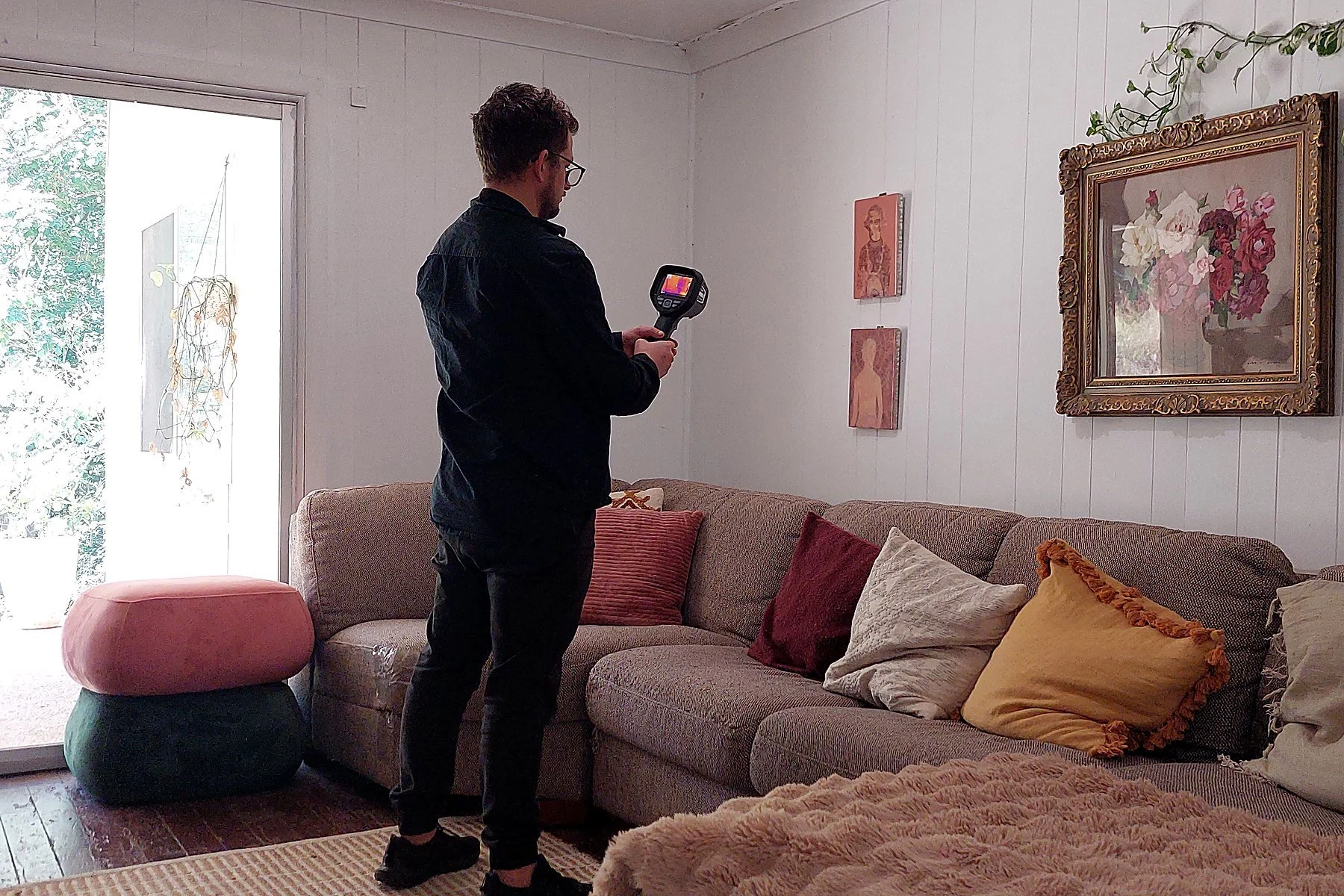
Temperature and relative humidity, logged at one-minute intervals while I am on site, so the pattern across the visit is recorded rather than a single spot reading. Carbon dioxide, which is a useful indicator of how much fresh air the room is getting when it is occupied. Moisture-indicator readings on the walls, window reveals and ceiling edges, each one recorded with its location, the material and the instrument mode. Thermal images of the surfaces where the conditions give a meaningful temperature difference, so cold spots at the reveals or the ceiling line are recorded rather than guessed.
Every reading is tied to a room, a surface or a marked point. That matters because a wet window in July and a dry one in September do not mean the cause has gone. They mean the season changed. A recorded starting point lets you compare like with like later.
What the record can and cannot say
The readings are the readings. My interpretation is separate, and I keep it that way in the report. I will say what the pattern indicates from nearly twenty years of building homes on this coast: whether the moisture looks like it is coming from the way the room is used, from the building fabric, or from below or above the ceiling line. I will say which of those needs a closer look, and by whom.
What the record will not do is identify mould, determine a health risk, or stand in for a building inspection, a pest inspection or an engineer. Where the readings support further investigation, the report names the location, explains why it deserves attention and names the right professional pathway.
When it is worth a closer look
If the condensation is in one room only, a Room Scan is usually enough to give you a measured starting point. If it is showing up in more than one room, or it comes with a musty smell that returns after cleaning, or you are about to renovate, a whole-home Baseline records the house as one connected picture rather than one room at a time.
Either way, the first step is a free 15-minute call. Tell me what you are seeing and I will tell you on the phone whether measuring will help, and which record fits.
Joe Heafey, licensed NSW builder 332487C. Coffs Harbour and the Mid North Coast.