High indoor humidity: what should be measured before buying ventilation equipment?
When a room feels humid or slow to dry, it is tempting to begin with a product: a larger fan, a dehumidifier, a vent or a mechanical system.
The stronger starting point is to define the room and record the conditions that the product is meant to change. Otherwise, you may know the equipment is running without having a clear starting record for the decision.
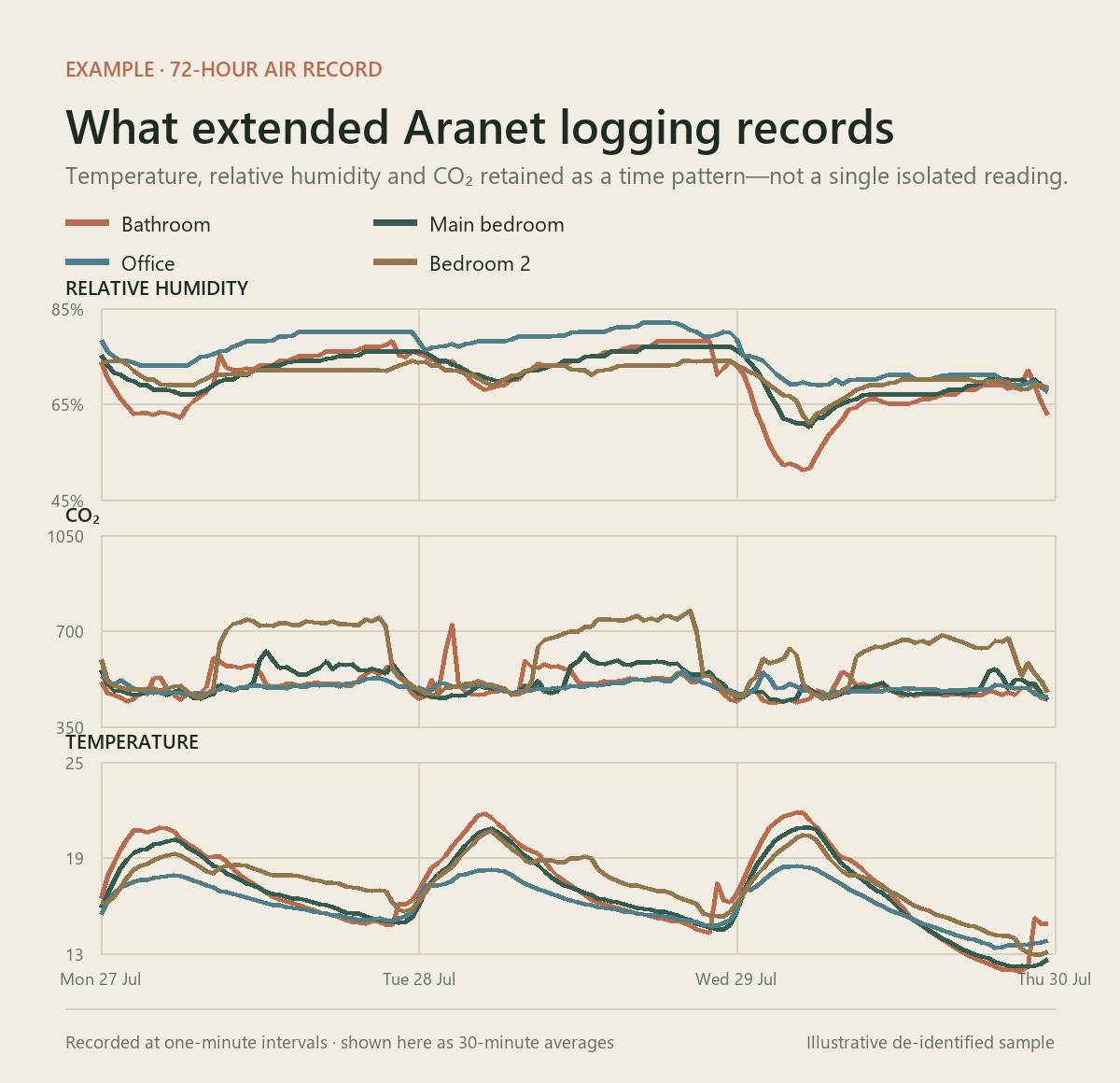
Record temperature and relative humidity together
Relative humidity changes with temperature, so the two readings should remain connected. Record the location, time and what the room was doing, not just the highest number visible on a monitor.
If longer monitoring is required, agree on the placement, duration and collection method before interpreting the result. A visit reading and an overnight or multi-day record are different types of evidence.
Record occupancy and room use
A bedroom overnight, bathroom after showering, laundry during drying or living room with several people will not present the same conditions. Doors, windows, heating and cooling can also change the record.
Carbon dioxide may add context in an occupied room, particularly where the reading is tracked over a defined period. It is not a direct measurement of whole-home ventilation rate and should not be presented as one.
Look at where moisture may be produced or retained
The assessment should note the room use, visible moisture sources, accessible surfaces, openings and relevant building context. Selected moisture-indicator readings or thermal images may be useful where the question supports them.
The aim is to understand the measured pattern, not to assign a concealed cause without the evidence or access required. If the same feeling appears across the house, the damp or musty home pathway describes the wider question.
Define what airflow test would be useful
Air speed at a grille, door gap or window is a local reading. It can answer a defined local question when the position and method are recorded. It is not the same as measuring whole-home air leakage or total air changes.
Before arranging airflow testing, define the location and decision it needs to support. Joe Builds offers local airflow measurement only by separate agreement. Formal blower-door testing is not currently offered.
Decide whether the equipment conversation needs another specialist
The measured record may help a ventilation supplier, designer, builder or heating and cooling specialist understand the room more clearly. Their role is still required where the work involves system design, electrical work, ducting, building alterations or formal performance calculations.
Joe Builds does not select or promise the performance of a product. The service records the current conditions and identifies the next sensible pathway.
Choose the right assessment extent
Use an Environmental Room Scan when one room is the clear question. Use a Home Performance Baseline when several rooms, floors or parts of the home need to be considered together.
The standard one-room scan is $825 inc GST. The whole-home Baseline starts from $1,815 inc GST. Airflow testing and extended logging are arranged separately.
Measure the room before choosing the equipment.
See what the Environmental Room Scan records and when the whole-home Baseline is the better fit.