

High-Performance Passive House Builder in Coffs Harbour
Designed for coastal humidity. Built for long-term comfort, health, and energy control.

High-performance homes designed for comfort, health, and long-term control
Most homes in Coffs Harbour are not built for the climate.
Humidity, heat, poor ventilation, inconsistent insulation, and weak detailing can lead to mould risk, unstable indoor temperatures, excessive air conditioning use, and buildings that simply do not perform the way people expect.
Passive House changes that.
Joe Builds designs and builds high-performance homes using Passive House principles to create healthier, quieter, more comfortable living environments with controlled energy use and better long-term durability.
We focus on homes that are built properly from the start, with construction systems that are designed to manage air, heat, moisture, and comfort in a measurable way.
What is a Passive House?
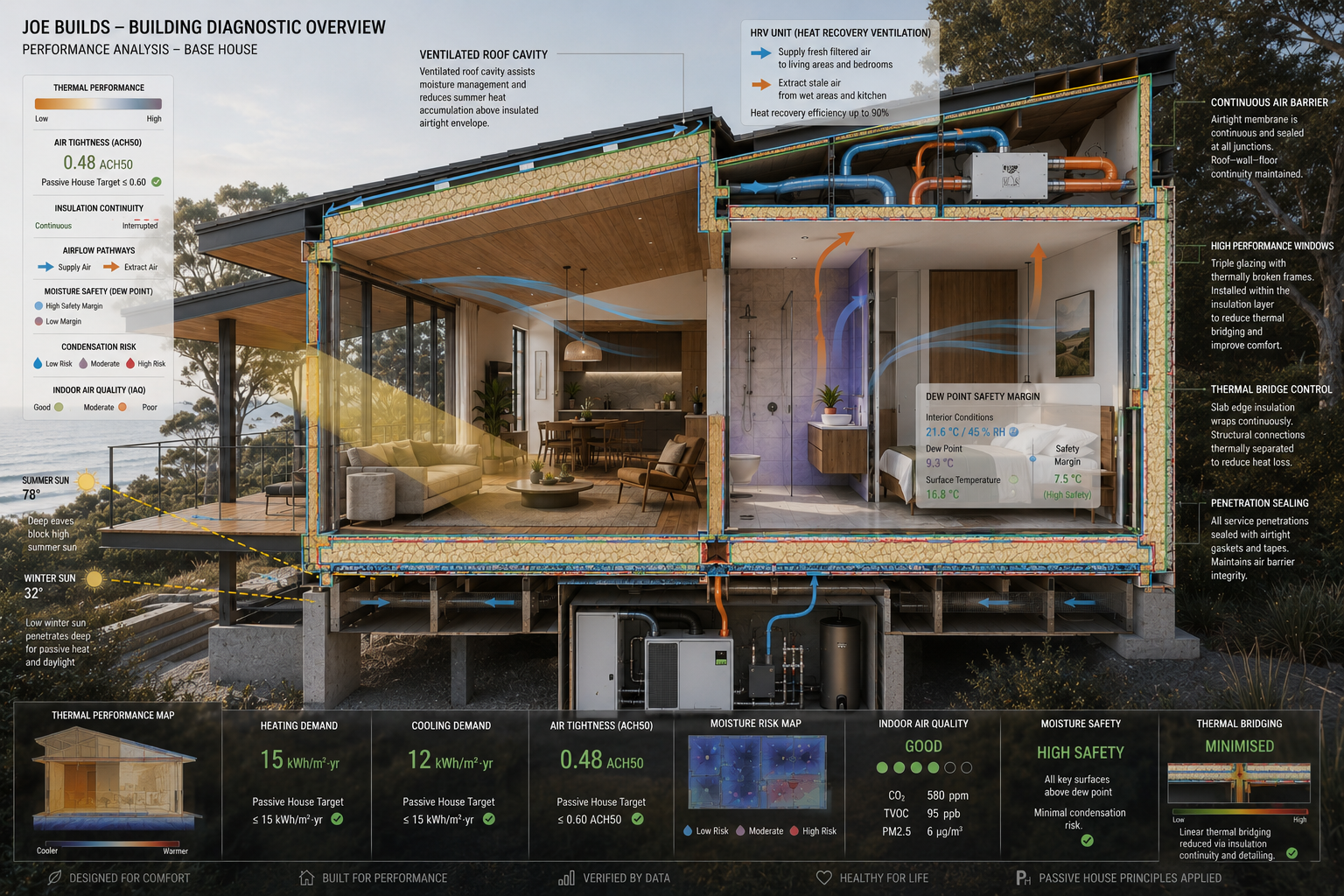
Passive House is a performance-based building standard focused on creating homes that maintain stable indoor temperatures, high air quality, and very low energy demand.
It is not a style or a visual trend. It is a construction methodology based on building science.
A Passive House is designed around five core principles:
Airtight construction
Continuous mechanical ventilation with heat recovery
High-performance insulation
Thermal bridge reduction
High-performance windows and doors
When these principles are designed and executed correctly, the result is a home that is quieter, healthier, more comfortable, and more efficient to run.
Why Passive House matters in Coffs Harbour
Coffs Harbour has a climate that puts pressure on buildings.
Heat, humidity, moisture, salt air, and seasonal temperature swings expose weaknesses in standard construction very quickly. Many homes look fine on the surface but perform poorly once people are living in them.
That often shows up as:
mould and condensation issues
rooms that are too hot or too cold
constant reliance on air conditioning
poor air quality
damp internal environments
high running costs
materials and finishes degrading faster than expected
Passive House principles help control these problems at the source.
Instead of relying on patch fixes after handover, the home is designed as a complete system from the beginning.
Passive House performance principles
High-performance windows and doors
Windows and doors are one of the most important parts of the building envelope.
The right systems improve temperature control, reduce unwanted air leakage, limit heat transfer, and contribute to acoustic comfort.
Airtight construction
A Passive House aims for a very high level of airtightness, typically no more than 0.6 air changes per hour at 50 Pascals.
That means uncontrolled air leakage is drastically reduced. Drafts are minimised, internal conditions are more stable, and moisture movement through the building envelope is better controlled.
Thermal bridge control
Thermal bridges are weak points where heat transfers through structural elements or junctions.
Reducing them is critical to improving efficiency, comfort, and condensation control.
Mechanical ventilation
Fresh air is supplied continuously through a mechanical ventilation system rather than relying on random leakage through gaps in the building.
This improves indoor air quality, removes stale air, and helps maintain a healthier internal environment.
High-performance insulation
Insulation is selected and installed as part of an overall performance strategy, not as a box-ticking exercise.
The goal is to reduce unwanted heat gain and heat loss so the home stays more stable throughout the year.
What a high-performance home actually gives you
A properly designed and built high-performance home can deliver:
more stable indoor temperatures year-round
lower heating and cooling demand
improved humidity control
fresher, filtered indoor air
reduced mould and condensation risk
quieter internal living spaces
greater comfort with less mechanical input
better long-term durability of the building fabric
This is not about luxury language. It is about measurable building performance and a better day-to-day living environment.
Joe Builds’ approach to Passive House
Joe Builds applies Passive House principles with a practical, buildable approach suited to local conditions.
We are not interested in adding performance language to a standard build. The point is to make the house actually work.
Our approach focuses on:
Climate-specific design thinking
Coffs Harbour is not Canberra, Melbourne, or inland NSW. Coastal humidity changes the way homes need to be detailed, ventilated, and managed.
We consider the local climate from the start so the building system is suited to real conditions, not generic assumptions.
Buildability from the start
A lot of design problems happen because buildability is not tested early enough.
We work from a construction-first mindset so detailing, sequencing, and material decisions are practical and realistic before they become expensive site issues.
Natural and low-tox material integration
Where appropriate, we aim to integrate materials and systems that support both performance and occupant wellbeing, including breathable assemblies and healthier material selections.
Controlled execution on site
High-performance homes require accuracy.
Airtightness detailing, insulation continuity, junction control, service penetrations, and sequencing all matter. Small mistakes create large performance losses.
Passive House and healthier living
Many people first come to high-performance building because they are tired of how normal homes behave.
They are tired of:
waking up to damp rooms
fighting condensation on windows
relying on constant air conditioning
dealing with musty smells
seeing mould return again and again
living in spaces that feel stale, noisy, or hard to regulate
For health-conscious families, retirees, and clients who want a better indoor environment, Passive House principles can create a major shift in how the home feels to live in.
A healthier home starts with the building envelope, ventilation strategy, moisture control, and material decisions. Those choices matter.
Passive House for new homes, renovations, and extensions
Passive House principles can be applied across different project types depending on the brief, budget, and existing conditions.
At Joe Builds, these principles may be considered for:
custom homes
design-led homes
secondary dwellings
major renovations
extensions
performance-focused upgrades to existing homes
Not every project needs full certification to benefit from better design and construction standards. In some cases, the right move is to apply core Passive House principles where they will have the greatest impact.
Our Process
Step 1 — Building Diagnostic (mandatory start)
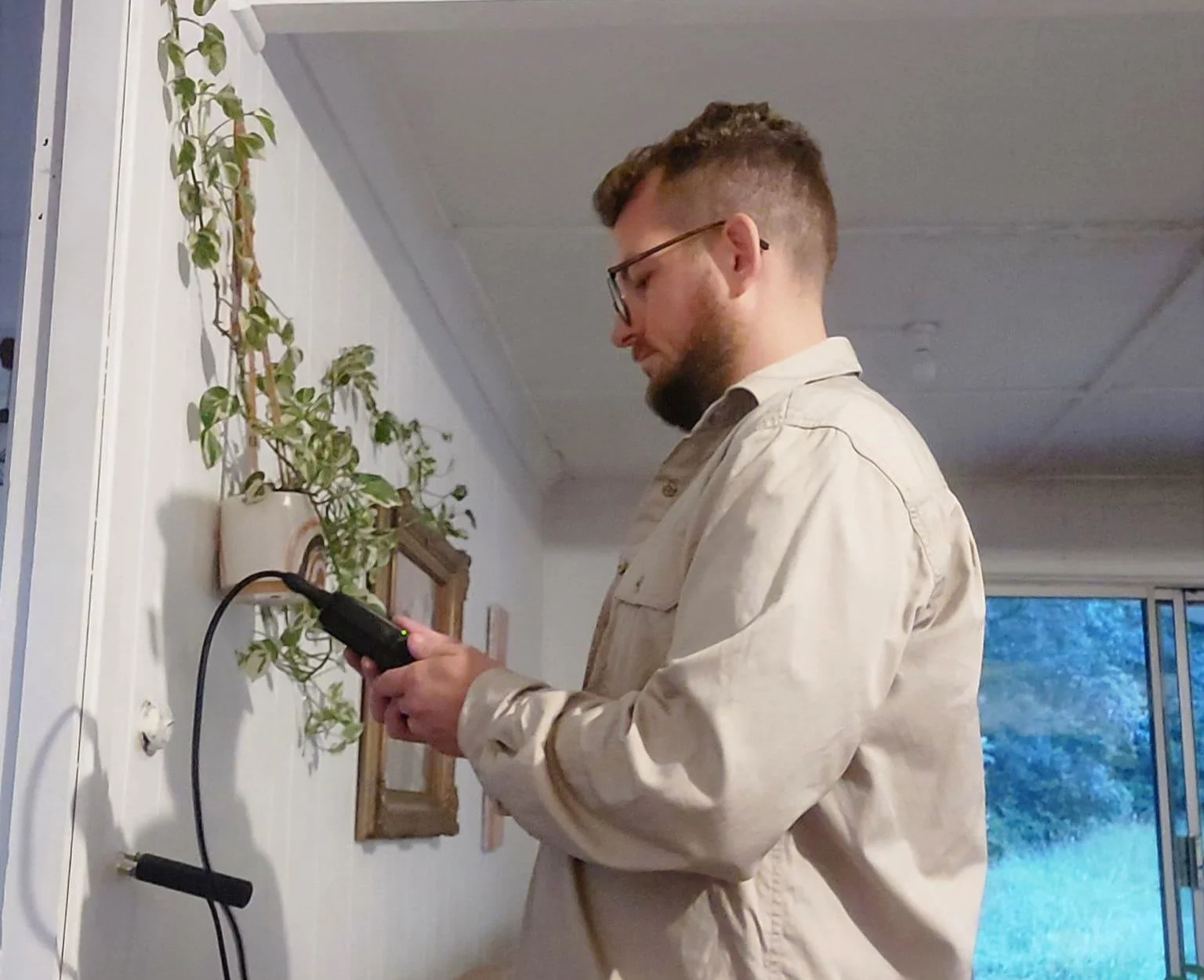
We assess moisture, air quality, thermal performance, and risk areas on site.
Step 2 — Scope Definition
We define exactly what needs to be built, repaired, or upgraded.
Step 3 — Feasibility & Cost Validation
We confirm planning, compliance, and realistic cost before design begins.
Step 4 — Design & Documentation
Only once the above is confirmed.
Step 5 — Construction
Controlled, documented delivery.
If Step 1 is skipped, the project carries risk. We don’t operate that way.
-
A standard home is usually built to minimum code requirements. A Passive House is designed and built to much tighter performance targets around air leakage, insulation, ventilation, and thermal control.
The result is a more stable, comfortable, and efficient internal environment.
-
It may still use heating or cooling systems depending on the project and climate, but the demand is significantly reduced because the building envelope performs far better than a standard home.
-
No. Passive House is highly relevant in mixed and warm climates because it helps control heat, humidity, air quality, and energy demand.
In Coffs Harbour, that makes it especially useful when combined with climate-appropriate design.
-
No. Some clients aim for formal certification. Others want to adopt Passive House principles without completing the full certification pathway.
The right approach depends on your goals, budget, and project type.
-
A high-performance home often requires more thought, better detailing, and stronger product selection upfront.
But the real question is not just initial cost. It is whether the building performs properly over time, costs less to run, reduces defects, and delivers a better living environment for decades.
-
Performance is usually assessed through detailed modelling and on-site testing.
One of the best-known tests is the blower door test, which measures airtightness and helps confirm whether the building is meeting its intended performance target.
-
Yes, but the strategy depends on the existing structure and constraints of the home.
Some renovation projects can achieve major gains by focusing on envelope upgrades, airtightness improvements, insulation, glazing, and ventilation.
Build better from the start
If you are planning a new home, renovation, or extension, the first step is to verify the project — not design it.
We assess moisture risk, thermal performance, air quality, and site conditions before any decisions are made.
This ensures the scope, cost, and pathway are defined on real information — not assumptions.
Joe Builds works with clients who want controlled outcomes, not reactive building.
Every project begins with a structured assessment before moving into feasibility, design, and construction.